free worldwide shipping | ships within 24 hours
G7X Camera: Complete 2026 Buyer’s Guide for Canon’s Iconic Series

Searching for a G7X camera? You have made a smart choice. The Canon series has been a favorite among vloggers, travelers, and content creators for nearly a decade. But here is the confusing part. There are three different models. The original. The Mark II. The Mark III. Which one should you buy in 2026?
This guide covers every camera ever made. You will learn the differences. You will understand which model fits your needs. And you will know exactly what to expect from your purchase.
What Is the G7X Series?
The Canon series is a line of premium compact cameras. Every model shares the same core formula: a 1-inch sensor, a bright f/1.8-2.8 zoom lens, and a pocketable body. The was designed for photographers who want professional image quality without carrying a large camera.
Over the years, Canon released three generations. Each improved on the last. But the basic concept remained the same. A is a camera you can take anywhere that still produces beautiful photos and videos.
The Three G7X Models Explained
Here are the three G7X cameras Canon has produced.
G7X (Original) – 2014
The original started everything. It featured a 20-megapixel 1-inch sensor and the famous 24-100mm f/1.8-2.8 lens. In 2014, this was revolutionary. No other pocket camera offered this combination of sensor size and lens brightness.
The original shoots 1080/60p video. It has a flip-up screen. It lacks a microphone input and 4K video. For its time, the was a breakthrough.
Best for: Budget buyers and photographers who only need 1080p video.
G7X Mark II – 2016
The G7X Mark II improved the original with a faster processor, better autofocus, and improved image stabilization. The sensor and lens remained identical to the original G7X.
The Mark II added a front grip for better handling. The screen still flipped up. Video specs remained 1080/60p. No 4K. No microphone input. But the Mark II was snappier and more responsive.
Best for: Those wanting a better handling experience without paying for Mark III features.
G7X Mark III – 2019
The G7X Mark III is the most advanced model. It added 4K video, a microphone input (on newer units), USB-C charging, and live streaming capabilities. The sensor remained 20 megapixels. The lens stayed the same.
The Mark III also introduced a headphone jack for audio monitoring. This was a big deal for vloggers. However, the Mark III has a major flaw: autofocus does not work in 4K mode.
Best for: Vloggers who need 4K video and microphone input.
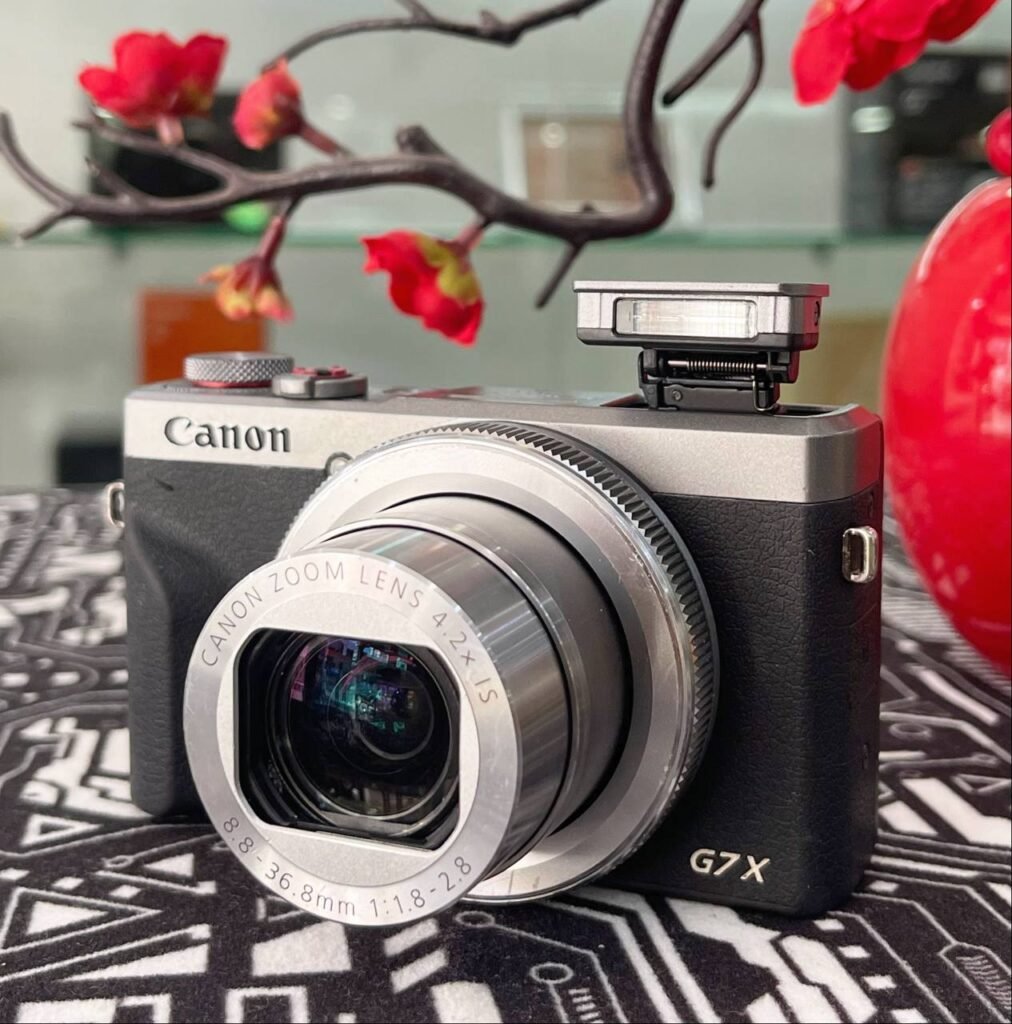
G7X Models Comparison Chart
| Feature | G7X Original | G7X Mark II | G7X Mark III |
|---|---|---|---|
| Release Year | 2014 | 2016 | 2019 |
| Sensor | 20MP 1-inch | 20MP 1-inch | 20.1MP 1-inch |
| Lens | 24-100mm f/1.8-2.8 | 24-100mm f/1.8-2.8 | 24-100mm f/1.8-2.8 |
| Max Video | 1080/60p | 1080/60p | 4K/30p, 1080/120p |
| Microphone Input | No | No | Yes (later units) |
| Headphone Jack | No | No | Yes |
| USB Charging | No | No | USB-C |
| Live Streaming | No | No | Yes |
| Continuous Shooting | 6.5 fps | 8 fps | 20 fps (electronic) |
| Battery Life | 210 shots | 265 shots | 265 shots |
| Weight | 279g | 294g | 304g |
| Current Used Price | $200-300 | $300-450 | $450-600 |
Which G7X Should You Buy in 2026?
Your choice of model depends on your budget and needs.
Buy the Original G7X if:
- You have a very tight budget (under $300)
- You only shoot 1080p video
- You primarily shoot still photos
- You want to try series before investing more
- You understand you are buying 10-year-old technology
The original still takes beautiful photos. But the autofocus is slow by modern standards. Battery life is shorter. And you cannot use an external microphone.
Buy the G7X Mark II if:
- Your budget is $300-$450
- You want better handling than the original
- You still only need 1080p video
- You appreciate the improved grip and processor
- You do not need 4K or a microphone input
The Mark II is the sweet spot for photographers. The handling improvements matter. The faster processor makes the camera feel modern enough. For stills, the Mark II is very capable.
Buy the G7X Mark III if:
- You need 4K video (even with autofocus limitations)
- You require an external microphone
- You want live streaming capabilities
- You want USB-C charging for travel
- Your budget allows $450-600
The G7X Mark III is the most advanced G7X. But understand the autofocus limitation before buying. In 4K, you focus manually. In 1080p, autofocus works fine.
The G7X Lens: Why It Matters
Every camera shares the same lens. This lens is the heart of the series. Here is why it is special.
The lens covers 24-100mm equivalent. At 24mm wide-angle, the aperture opens to f/1.8. This is very bright. It creates beautiful background blur. It works well in low light.
At 100mm telephoto, the aperture is f/2.8. Still very bright for a zoom lens. Most compact zoom lenses get much darker at telephoto (f/5.6 or worse). The maintains brightness throughout the zoom range.
No other pocket camera offers this zoom range with such brightness. Sony’s ZV-1 stops at 70mm. DJI’s Osmo Pocket has a fixed 20mm lens. The lens is unique.
G7X for Photography: Still Excellent
For still photography, every model remains excellent. The 1-inch sensor produces sharp, detailed images. Canon’s color science handles skin tones beautifully. The bright lens works indoors and at night.
A G7X camera captures RAW files. You can edit them extensively. The dynamic range is good for a 1-inch sensor. For travel, street, and everyday photography, the G7X is wonderful.
Here is what you can expect from G7X image quality:
- Sharp details in good light
- Usable images up to ISO 1600
- ISO 3200 in a pinch
- Beautiful background blur at f/1.8
- Accurate colors straight from camera
G7X for Video: Know the Limitations
The series has a complicated relationship with video.
Original G7X and Mark II
These models shoot 1080/60p video. No 4K. No microphone input. The autofocus is contrast-detection only. It works reasonably well in good light but can hunt in low light.
For casual video, these models are fine. For professional vlogging, they are not suitable.
G7X Mark III
The Mark III added 4K video and a microphone input. This was huge for vloggers. However, there is a major catch.
When shooting 4K on the Mark III, autofocus is disabled. You must focus manually. This is a serious limitation for vlogging. Sony’s ZV-1 from the same era has full autofocus in 4K.
In 1080p mode, the Mark III autofocus works fine. So if you are happy with 1080p video, the Mark III works well. But if you need 4K with autofocus, look elsewhere.
G7X vs Smartphones in 2026
How does a compare to a modern smartphone? This is an important question in 2026.
| Feature | G7X Series | 2026 Smartphone |
|---|---|---|
| Optical Zoom | 24-100mm (4.2x) | 3-5x typical |
| Sensor Size | 1-inch | 1-inch (flagships) |
| Aperture | f/1.8-2.8 (physical) | Computational |
| Background Blur | Natural optical | Simulated |
| Low Light | Good | Very good (computational) |
| Video Autofocus | Limited on Mark III | Excellent |
| Portability | Pocketable | Very pocketable |
| Battery Life | 265 shots | All day |
| Sharing | Requires transfer | Instant |
For optical zoom and natural bokeh, a wins. For convenience and computational photography, a smartphone wins. Choose based on your priorities.
Common G7X Problems to Know
Every G7X model has known issues. Be aware before buying.
Lens Mechanism Failure
The G7X lens extends when powered on. This mechanism can fail. Sand, dust, or drops cause the lens to jam. Repair costs often exceed the camera’s value.
Overheating (Mark III)
The Mark III overheats in 4K mode. After 15-20 minutes, the camera may shut down. This is less common in 1080p.
No 4K Autofocus (Mark III)
As mentioned, the Mark III has no autofocus in 4K. This is not a defect. It is a design limitation. Canon never fixed this with firmware.
Battery Life
battery life is mediocre. The original lasts about 210 shots. The Mark II and III last about 265 shots. For video, expect 60-90 minutes. Buy spare batteries.
G7X Accessories You Need
These accessories improve any camera.
Spare Batteries
The NB-13L battery is used by all models. Buy 2-3 spare batteries. Third-party options are affordable.
Screen Protector
The flip-up screen is exposed when closed. A glass screen protector prevents scratches. This is essential for cameras.
Small Tripod
A Joby GorillaPod or tabletop tripod holds your steady. The lightweight body works well with small tripods.
External Mic (Mark III Only)
If you buy the Mark III, add a Rode VideoMicro or DJI Mic. The internal microphone picks up handling noise.
Ready to buy a camera? Visit our Shop compact / vlog cameras category for availability at Camerion Cameras.
Frequently Asked Questions About G7X Cameras
Which G7X model is best for beginners?
The Mark II is best for beginners. It costs less than the Mark III. It handles well. It avoids the 4K autofocus confusion of the Mark III. For learning photography, the Mark II is perfect.
Is the G7X good for YouTube?
Yes, but with caveats. The Mark III with an external microphone works well for YouTube if you shoot in 1080p. The Mark II also works but lacks a mic input. The original is not recommended for YouTube.
Does the G7X have a viewfinder?
No model has a viewfinder. You compose using the rear screen. The screen flips up for selfies. In bright sunlight, the screen can be hard to see.
Is the G7X good for travel?
Yes. The series is excellent for travel. The camera is small enough for any bag. The zoom lens covers wide-angle landscapes and telephoto details. Image quality is superb for the size.
Will Canon release a G7X Mark IV?
Canon has not announced a Mark IV. As of 2026, no official release date exists. Do not wait for a Mark IV if you need a camera now.
G7X vs Sony ZV-1: Which Wins?
The Sony ZV-1 is the Mark III‘s main competitor.
| Feature | Canon G7X Mark III | Sony ZV-1 |
|---|---|---|
| Lens | 24-100mm f/1.8-2.8 | 24-70mm f/1.8-2.8 |
| 4K Autofocus | No | Yes |
| Microphone Input | Yes (later units) | Yes |
| Screen | Flip-up | Side-flip |
| Color Science | Excellent skin tones | Accurate |
| Used Price | $450-600 | $500-650 |
The Sony ZV-1 wins for 4K autofocus. The wins for zoom range and color science. Choose based on your priorities.
Conclusion: Which G7X Should You Buy in 2026?
The G7X series remains relevant in 2026 for specific users.
Buy the original if you have under $300 and only shoot photos or 1080p video casually.
Buy the Mark II if you want the best value for still photography and prefer 1080p video without needing a microphone.
Buy the Mark III if you need 4K video (accepting manual focus) or require a microphone input for vlogging.
For most buyers in 2026, the Mark II offers the best balance. You save money compared to the Mark III. You get excellent stills and good 1080p video. You avoid the 4K autofocus frustration.
The series is not perfect. Autofocus is behind modern standards. Battery life is mediocre. The Mark III has serious 4K limitations. But the lens remains unique. No other pocket camera offers 24-100mm f/1.8-2.8.
If you understand the trade-offs, a camera will serve you well for years. The photos are beautiful. The portability is unmatched. And the series has a character that newer cameras cannot replicate.